ANNE ELISE KOPPES – PhD Candidate, Duke University
This post is in conjunction with a conference paper presented at the American Musicological Society Conference in Minneapolis, MN, November 2025. Below, you will find referenced archival materials that accompany the lecture, courtesy of the Rosetta Reitz papers at the David M. Rubenstein Rare Book and Manuscript Library at Duke University.
Thank you to Tift Merritt, Lou Brown, Laura Micham, and Craig Breaden for your assistance in archive digitization and thoughtful collaboration.
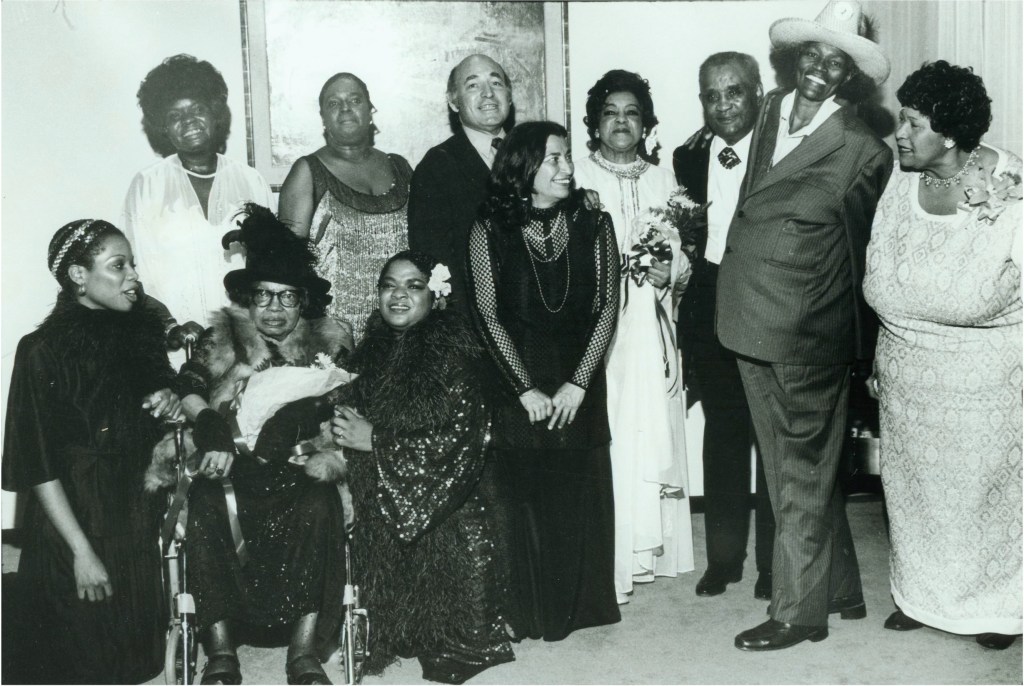
Rosetta Reitz with “Blues is A Woman” performers at Newport Jazz Festival, 1980.
(Standing, l to r): Koko Taylor, Linda Hopkins, George Wein, Rosetta Reitz, Adelaide Hall, Little Brother Montgomery, Big Mama Thornton, Beulah Bryant; (seated, l to r); Sharon Freeman, Sippie Wallce, Nell Carter. Image courtesy of David M. Rubenstein Library at Duke University. Copyright Barbara Weinberg Barefield.
Abstract
This paper examines “Blues Is a Woman” (1980), a concert conceived and produced by feminist jazz and blues historian Rosetta Reitz for the Newport Jazz Festival, as a site for understanding how feminist historiography and psychoanalytic fantasy intersect in late twentieth-century blues revivalism. Framed by Reitz as her “fantasy concert,” the event sought to reconstitute blues history by restoring women’s foundational presence to a canon long centered on male innovation. Drawing on theories of the phantasmatic developed by Judith Butler and Jean Laplanche, I argue that “Blues Is a Woman” dramatizes the psychic and historiographical processes through which gendered and racialized desires and anxieties shape musical canons. Using Freud’s concepts of condensation and displacement, I show how social anxieties surrounding race, class, and gender were condensed within blues historiography and displaced onto the figure of the Black male innovator, who came to embody the phantasm of authenticity. In this process, Black women’s artistry was doubly effaced—first through the masculinized condensation of the canon, and then through the displacement of their expressive multiplicity onto the figure of the Black “authentic” male genius. Reitz’s concert reconfigures this structure by staging a “counter-phantasmatic” scene that foregrounds women’s creative authority and collective labor. Yet, as critics such as Thulani Davis observed, her intervention risked producing new condensations that flattened the racial and musical specificities of women’s blues into a universalizing feminist narrative. Situating Blues Is a Woman within debates on canonicity, feminist desire, and historical recovery, I argue that Reitz’s project reveals both the reparative and precarious dimensions of fantasy in music historiography.
Thulani Davis review in Village Voice, 1980.
Reitz letter to the Village Voice, 1980. Response to Thulani Davis and Chris Albertson.
“Lay Your Hands On Me” recording from 1980 Newport Jazz Festival. Lyrics by Reitz. Music by Hyman. Performance by Nell Carter. Thank you to Craig Breaden for audio digitization at the Rubenstein Rare Book and Manuscript Library, Duke University.
Surviving program guide for the 1981 Blues Is a Woman performance at the Hollywood Bowl, one year following the Newport Jazz Festival premiere.
Bibliography
Barclay, Dolores. “The Blues Is a Woman.” Ebony, September 1980.
Brooks, Daphne A. “‘A Woman Is a Sometime Thing’: (Re)Covering Black Womanhood in Porgy and Bess.” Daedalus 150, no. 1 (2021): 98–117.
Butler, Judith. Who’s Afraid of Gender? New York: Farrar, Straus and Giroux, 2024.
Davis, Thulani. “The Blues Talk Back.” The Village Voice (New York, NY), 1980. The Rosetta Reitz Papers in the David M. Rubenstein Rare Book Manuscript Collection (Box 8).
Jones, LeRoi. Blues People: Negro Music in White America. New York: William Morrow, 1963.
Monson, Ingrid. “The Problem with White Hipness: Race, Gender, and Cultural Conceptions in Jazz Historical Discourse.” Journal of the American Musicological Society 48, no. 3 (1995): 396–422.
Nash, Jennifer C., and Samantha Pinto, eds. “Everybody’s Maybes: Reproducing Feminism’s Bad Objects.” South Atlantic Quarterly, Feminism’s Bad Objects, vol. 122, no. 3 (2023).
Reitz, Rosetta. “Blues Is a Woman Program Notes.” Newport Jazz Festival, 1980. The Rosetta Reitz Papers in the David M. Rubenstein Rare Book Manuscript Collection.
Reitz, Rosetta. “Whose Blues?” Letters. Village Voice (New York, NY), August 8, 1980.
Wilson, John S. “Newport Jazz ‘Blues Is a Woman’ Tonight Explores Other Sides of the Blues.” New York Times (New York, NY), July 2, 1980.

 a.e. koppes - music
Leave a comment